
Blanched Hazelnut Kernels: Industrial Specifications Explained
Blanched hazelnut kernels are a premium ingredient widely used in chocolate, confectionery, bakery, roasting and paste production. This guide provides a complete breakdown of skin-removal performance, moisture targets, size calibrations, defect tolerances, and quality parameters used by industrial buyers when sourcing from Türkiye.
What are blanched hazelnut kernels?
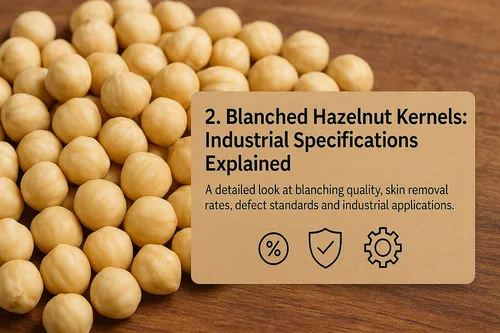
Blanching is the process of removing the natural brown skin from raw hazelnut kernels. Turkish hazelnuts, particularly Tombul, achieve excellent skin removal rates due to their naturally thin skin structure. This makes blanched kernels the preferred format for chocolate, pralines, roasting applications and premium baked goods.
Industrial buyers evaluate blanched kernels using strict physical, chemical and visual standards. These metrics determine product performance during roasting, enrobing, refining, milling, and downstream processing.
1. Skin removal performance
The main quality indicator of blanched kernels is the skin removal rate, expressed as a percentage. The standard requirement for export-grade blanched kernels is:
- ≥ 98% skin removed — premium grade, required by most chocolate manufacturers.
- 95–97% skin removed — acceptable for roasting and bakery applications.
- < 95% — used mainly for internal processing, not preferred for export.
Skin removal consistency directly affects the visual appeal of chocolate inclusions and the particle color uniformity in hazelnut paste or praline.
2. Industrial defect tolerances
Defects in blanched kernels must be lower than raw kernels, since blanching exposes the surface and makes imperfections visible. Typical industry tolerances include:
- Damaged kernels: ≤ 2%
- Stained / dark kernels: ≤ 2–4% depending on customer specification
- Mouldy kernels: Nil allowed
- Foreign matter: Nil
- Shriveled kernels: ≤ 1–3% depending on grade
For retail-packing and chocolate applications, buyers often request even tighter tolerances to maintain visual consistency.
3. Moisture & chemical parameters
Moisture content has a direct impact on roasting behavior, crunch, microbiology and shelf stability. Standard specifications are:
- Moisture: 2–4% for blanched kernels
- Peroxide value (PV): Low values preferred, depending on freshness
- Free fatty acids (FFA): Controlled according to buyer limits
- Aflatoxins: Certified lots available with full documentation
Proper drying and vacuum packing help stabilize these parameters during long-distance export.
4. Size calibration (calibers)
Blanched kernels follow the same caliber standards as raw kernels. Popular size groups include:
- 9–11 mm · used for chopping & milling
- 11–13 mm · most common for general applications
- 13–15 mm · premium for whole chocolate inclusions
- 14–16 mm / 15+ mm · limited, specialty grades
Calibration accuracy is essential for roasting uniformity and even heat distribution during chocolate enrobing and bakery processing.
5. Typical applications of blanched kernels
- Chocolate production: used in pralines, bars and premium inclusions.
- Roasting lines: produce glossy, aromatic roasted kernels.
- Bakery & pastry: chopped or sliced for doughs, toppings and fillings.
- Pastes & praline: ensures uniform color and flavor after milling.
- Retail packing: especially for premium whole-nut products.
Because the surface is fully exposed, blanched kernels offer a clean, bright appearance preferred for consumer-facing products.
6. Packaging & export considerations
Blanched hazelnuts are highly sensitive to oxidation. Proper packing and handling are essential for maintaining quality. Exporters typically offer:
- Vacuum 25 kg bags (most common)
- Carton-packed vacuum bags for premium programs
- Big bags for industrial processors
- CFR / FOB / DAP delivery depending on destination
Cold-chain storage is optional but recommended for long transit times to warm climates.
7. What buyers should specify
To ensure the correct grade is supplied, buyers should clarify:
- Desired caliber (size range)
- Moisture target
- Defect tolerance levels
- Skin removal rate requirement
- Packing type (vacuum, PP, carton)
- Intended application (chocolate, roasting, paste, bakery)
Providing this information allows suppliers to match the correct lot and processing line.
Need blanched hazelnut kernel specifications?
Send us your caliber, skin removal, defect tolerance and packing requirements.