
Choosing Packaging Options for Hazelnut Export
Packaging is a critical control point in the hazelnut export chain. The right solution balances product protection, moisture control, shelf life, container efficiency and handling at destination. This guide explains how to choose between vacuum-packed bags, polypropylene sacks, cartons and big bags for bulk hazelnut shipments.
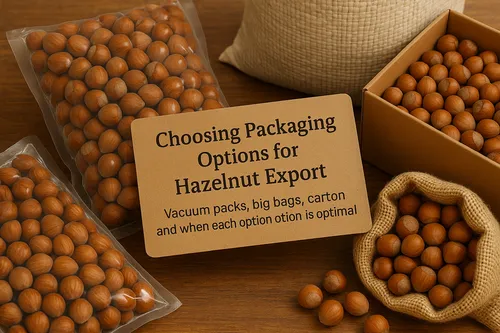
1. Why packaging matters in hazelnut export
Hazelnuts are a high-value, oil-rich ingredient. Poor packaging can lead to oxidation, moisture pickup, physical damage and quality claims at destination. For industrial buyers, packaging is not just a logistics choice – it is a key part of the quality and food safety specification.
- Moisture & oxygen control: to protect flavor, texture and shelf life.
- Mechanical protection: to limit breakage and kernel damage in transit.
- Handling efficiency: to match warehouse equipment and production line needs.
- Traceability & documentation: clear labelling and pallet mapping.
The “best” hazelnut packaging solution will depend on product format (kernels, chopped, meal, paste, oil), shipment route, climate, warehouse infrastructure and buyer preferences.
2. Vacuum-packed hazelnut bags: when and why to use them
Vacuum-packed bags are widely used for kernels, chopped formats and hazelnut meal destined for long-distance export and high-spec applications such as premium chocolate, spreads or retail packing.
Typical configuration
- Bag sizes: 10 kg, 20 kg or 25 kg net.
- Outer protection: cartons or stacked on pallets and stretch-wrapped.
- Film types: multilayer films with good oxygen and moisture barriers.
Advantages
- Reduced oxygen exposure and slower oxidation of hazelnut oil.
- Stable moisture level throughout the supply chain.
- Improved shelf life, especially in warm or humid climates.
- Professional appearance and easier handling in many warehouses.
Points to consider
- Higher packaging cost than simple PP bags.
- More labor and equipment required during packing.
- Need for careful handling to avoid punctures in the vacuum bags.
3. Polypropylene (PP) bags for hazelnut export
Traditional PP bags are still widely used for certain hazelnut formats and markets, especially where cost and simplicity are prioritized over extended shelf life.
Typical use cases
- In-shell hazelnuts for further industrial cracking.
- Certain kernel shipments where product will be used quickly after arrival.
- Markets with short transit time and cooler climate.
Advantages
- Lower packaging cost per metric ton.
- Simple, familiar handling in ports and warehouses.
- Flexible packing densities and easy stacking.
Limitations
- Limited protection against moisture and oxygen.
- Higher risk of product deformation and breakage in fine formats.
- Shorter recommended shelf life compared with vacuum-packed formats.
4. Cartons, palletization & warehouse efficiency
Many industrial buyers prefer hazelnuts to arrive in cartons on pallets, especially for vacuum-packed kernels, chopped nuts and meal. This format optimizes traceability and integration with modern warehouse and line-feeding systems.
Benefits of using cartons
- Better stack stability inside the container and in the warehouse.
- Protection against mechanical damage and puncturing of internal bags.
- Cleaner appearance for quality audits and customer visits.
- Space for clear labelling: product code, batch, production date, best-before date.
Pallet configuration (e.g., 1,000 kg per pallet, 40 cartons of 25 kg) is usually defined in the specification sheet so that both sides plan storage and internal logistics correctly.
5. Big bags (FIBCs) for industrial hazelnut users
Big bags / FIBCs are used when large continuous volumes are processed in-house, such as cracking, roasting or further industrial transformation. They are more common for in-shell hazelnuts or intermediates, and less common for finished kernel formats that require strict defect control.
Key advantages
- Very efficient loading and unloading for high-volume plants.
- Lower packaging cost per ton compared with small bags and cartons.
- Suitable for internal logistics when bulk tipping or silo systems are in place.
Risks and considerations
- More pressure on the product at the bottom of the bag (possible breakage).
- Less fine-grained batch control compared with smaller bags.
- Handling equipment (forklifts, hooks) must be compatible with FIBCs.
6. Matching packaging to climate, route & shelf life
Packaging must be evaluated together with the route, transit time and climate. A format that works well for a short route to a temperate market may be insufficient for long, hot, humid routes.
- Warm & humid destinations: vacuum-packed bags and cartons are often preferred.
- Cool, nearby markets: PP bags may be sufficient for kernels and in-shell products.
- Very long ocean routes: consider vacuum plus robust palletization and container insulation or proper ventilation.
Industrial buyers should align expected stock turnover with packaging choice. If hazelnuts will sit in storage for several months, higher protection is usually justified.
7. Buyer checklist for hazelnut export packaging
To define the right packaging solution for your hazelnut program, procurement and quality teams should clarify the following points with their supplier:
- Product format (kernels, roasted, chopped, meal, paste, oil, in-shell).
- Annual volumes and typical shipment size (palletized or bulk containers).
- Destination country, transit time and seasonal climate conditions.
- Preferred packaging (vacuum bags, PP bags, cartons, big bags) and palletization scheme.
- Target shelf life and maximum storage time at destination.
- Labelling requirements: allergen declarations, traceability codes, language and regulations.
Properly defined packaging specifications reduce complaints, minimize logistics risks and improve the long-term performance of hazelnut ingredients in your supply chain.
Need help defining hazelnut export packaging?
Share your product formats, route and storage conditions. We’ll recommend suitable packaging and pallet configurations for your hazelnut program.