
Hazelnut Blending & Formulation Strategies
Hazelnuts blend exceptionally well with cocoa, dairy, plant-based matrices, grains and fats. Understanding how hazelnut ingredients behave in multi-component formulations is essential for creating successful spreads, chocolates, bakery fillings, beverages and nutritional systems.
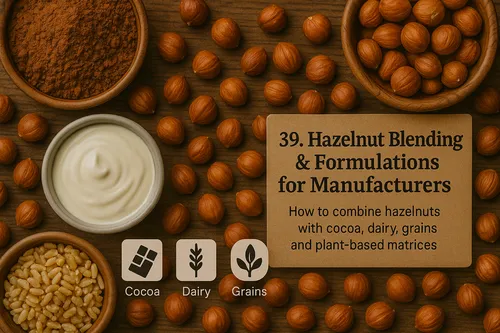
1. Why hazelnuts are ideal for blending and formulation
Hazelnuts offer natural emulsification behavior, high oil content, a premium flavour profile and strong compatibility with both indulgent and clean-label product categories. These traits make them suitable for blending with:
- Cocoa and chocolate systems
- Dairy fats and vegetable fats
- Grains, cereals and extruded bases
- Plant-based proteins and emulsifiers
- Sweeteners (sugar, syrups, natural alternatives)
When formulated correctly, hazelnuts enhance flavor, provide structural functions, reduce reliance on additives and increase consumer-perceived quality.
2. Cocoa & hazelnut blends: the core of pralines, spreads & fillings
Hazelnuts are the primary nut used in chocolate spreads, pralines and gianduja fillings due to their compatibility with cocoa solids and cocoa butter. Roast intensity and paste consistency largely determine flavor release and stability.
Typical industrial formulation ratios
- Classic gianduja: 20–40% hazelnut paste, rest cocoa mass + sugar
- Premium spreads: 12–18% hazelnut paste
- Chocolate bars: whole / chopped nuts at 10–25% inclusion
Key formulation challenges
- Particle size uniformity affects smoothness and oil migration.
- Hazelnut oil interacts with cocoa butter; improper ratios cause softening.
- Roast profile must be balanced to avoid masking cocoa notes.
Correcting viscosity often requires adjusting sugar granulometry or adding stabilizing fats.
3. Hazelnuts blended with dairy fats and vegetable fats
Hazelnut paste integrates smoothly into fat systems and enhances creaminess. This makes it ideal for ice cream, ganache, fillings, spreads and butter substitutes.
Blending considerations
- Dairy fat improves melting profile but increases oxidative sensitivity.
- Vegetable fats can stabilize oil migration when appropriately structured.
- Hazelnut oil content (60–65%) must be accounted for in total fat phase calculations.
In frozen systems, hazelnut paste prevents ice crystal growth and enhances mouthfeel due to its lipid composition and natural emulsifier behavior.
4. Blending hazelnuts with grains, cereals & extruded products
In cereal, granola and extrusion applications, hazelnuts provide both functional and nutritional enhancement. Whole, chopped and meal formats are used widely in:
- Granola and muesli mixes
- Extruded cereal clusters
- High-fiber snack bars
- Protein-enriched baked snacks
Functional benefits
- Hazelnut meal adds richness and improves texture in gluten-free systems.
- Chopped formats provide crunch without excessive hardness.
- Hazelnut flour enhances binding ability in cereal dough matrices.
5. Blending hazelnuts in plant-based and clean-label formulations
As the global shift toward plant-based innovation accelerates, hazelnuts offer a naturally rich, dairy-like flavor profile and functional fats that improve creaminess, mouthfeel and consumer acceptance.
Applications
- Plant-based beverages
- Vegan spreads & desserts
- Nut-based yogurts
- Protein bars and nutritional snacks
Important formulation factors
- Correct emulsifier selection prevents separation in beverages.
- Particle size control improves suspension stability.
- Hazelnut oil adds desirable aroma but must be balanced with texture needs.
6. Blending hazelnuts with sweeteners & sugar alternatives
Sweeteners strongly affect hazelnut flavor release, viscosity and mouthfeel. Both traditional sugars and natural low-calorie options are commonly used.
Key effects of sweetener choice
- Sucrose provides clean sweetness and enhances aromatic perception.
- Invert sugar / glucose syrup reduces crystallization in spreads.
- Polyols (e.g., maltitol) require viscosity correction.
- Stevia / monk fruit need masking strategies to avoid off-notes.
Sweeteners also influence water activity (aW), which impacts shelf life and microbiological stability.
7. How to design a hazelnut blend that performs in industrial production
Successful hazelnut blending requires controlling three main variables:
- Texture — particle size, viscosity, inclusion size
- Flavor — roast intensity, cocoa interaction, sweetness level
- Stability — oil migration, moisture, oxidation resistance
Best practices for R&D teams
- Test multiple roast profiles during early formulation.
- Request samples from different origins to compare flavor nuance.
- Balance fat phases carefully to prevent softness or separation.
- Consider packaging format early, as it impacts shelf life and stability.
8. Summary
Hazelnuts blend seamlessly with cocoa, fats, grains and plant-based systems due to their rich flavor and unique lipid profile. Skilled formulation — adjusting texture, viscosity, sweetness, and roast profile — results in high-performing products across confectionery, bakery, snacks, beverages and modern plant-based applications.
Need support designing a hazelnut blend?
Share your formulation requirements and target application. Our team supports R&D and procurement professionals worldwide.