
Volume Planning for Hazelnut Procurement
Effective volume planning is essential for manufacturers and importers working with hazelnuts, especially given seasonal harvest cycles, global supply fluctuations and capacity constraints at processing facilities. This guide provides a structured approach to forecasting annual hazelnut requirements, mitigating risk and securing stable long-term supply.
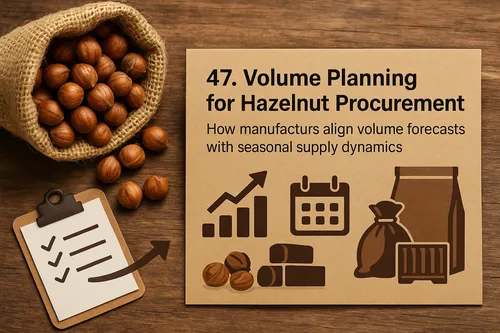
1. Understanding the seasonality of hazelnut supply
Hazelnuts follow an annual crop cycle, with Türkiye—responsible for over 60% of global production— harvesting between August and October. This means that the bulk of available raw material enters the supply chain in Q3 and Q4, with availability tightening in the later months if forecasts are inaccurate.
Effective volume planning requires aligning internal demand with the natural availability cycle, particularly for buyers who need calibrated kernels, blanched products, or paste/powder inputs with specific technical requirements.
2. Forecasting annual requirements
Volume forecasts should be based on a combination of historical usage, projected sales and NPD (new product development) activity. Key forecasting elements include:
- Historical consumption: Extract monthly and quarterly usage averages.
- Planned production increases: New SKUs, seasonal launches, expanded markets.
- Waste and process loss factors: Particularly relevant for roasting, chopping and paste production.
- Shelf life: Longer shelf-life products allow for larger pre-season purchases.
Manufacturers typically forecast hazelnut needs 6–12 months ahead to secure competitive pricing and ensure supplier readiness.
3. Balancing contract volumes with spot buying
A strong procurement strategy balances the stability of contracted volumes with the flexibility of spot market purchases. Each approach offers advantages:
Contract Buying
- Stable pricing and supply guarantees
- Preferred access to premium calibers
- Ideal for annual programs with predictable consumption
Spot Buying
- Flexibility to respond to short-term needs
- Opportunity to buy at dips in market pricing
- Useful for seasonal demand spikes
Many industrial buyers use a hybrid approach—contracting 70–90% of expected volume and sourcing the remaining portion based on market dynamics.
4. Aligning purchasing with processor capacity
Hazelnut processors operate with finite cracking, sorting and blanching capacity. Buyers with significant volume requirements must coordinate schedules and specifications early in the season.
Key considerations:
- Lead times: Blanching and custom roasting may require 1–4 weeks depending on load.
- Caliber availability: Larger sizes (13–15 mm and above) have limited supply.
- Organic materials: Often subject to strict capacity windows.
Strategic buyers reserve production slots with processors to guarantee timely delivery during peak seasons.
5. Managing risks: inventory, price volatility & crop variation
Because hazelnut prices and yields can shift significantly year to year, a strong procurement plan incorporates proactive risk management.
Primary risks include:
- Crop variability: Weather fluctuations impact yields, kernel size and defect rates.
- Market volatility: Influenced by supply/demand, currency and global nut markets.
- Quality inconsistency: Particularly relevant for long-term storage and late-season buying.
Mitigation strategies
- Early contracting during harvest season.
- Using vacuum-packed formats to extend shelf life.
- Diversifying across formats (raw, blanched, chopped, paste).
- Implementing rolling forecasts with quarterly adjustments.
6. Multi-format planning for manufacturing efficiency
Many manufacturers use multiple hazelnut formats (e.g., raw kernels, roasted kernels, chopped, sliced, paste, flour). Forecasting must reflect conversion losses between formats.
Typical conversion relationships:
- Raw kernels → roasted kernels: 3–5% weight loss
- Raw kernels → chopped kernels: dependent on granulation & breakage
- Raw kernels → paste: roast level and oil release impact yield
- Raw kernels → flour: contingent on oil content and milling parameters
Including these yield factors in demand forecasts prevents shortfalls during production cycles.
7. Annual planning timeline for hazelnut buyers
A typical planning cycle for professional procurement teams:
- Q1: Analyze prior year usage and build demand forecast.
- Q2: Begin discussing preliminary volume with suppliers.
- Q3: Harvest outlook & price discovery; finalize contracts.
- Q4: Ship early-season loads and secure logistics windows.
For high-volume buyers, this timeline ensures optimization of both cost and quality.
8. Benefits of long-term supplier partnerships
Stable relationships with exporters and processors improve forecasting accuracy and strengthen supply chain resilience.
- Access to early-season lots and premium calibers.
- Priority processing for custom specifications.
- Better alignment between QA teams and supplier capabilities.
- Improved pricing efficiency for multi-year commitments.
Atlas Hazelnuts works with buyers to structure multi-shipment and multi-format programs tailored to annual volume cycles.
Need help planning your annual hazelnut volumes?
Share your forecast, formats and production schedule. We will prepare a tailored sourcing plan.