
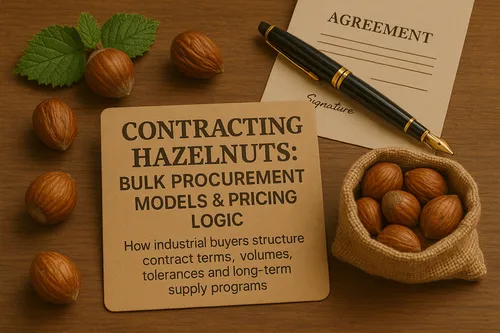
Contracting Hazelnuts: Bulk Procurement Models & Pricing Logic
For industrial users of hazelnuts, the way you structure contracts is just as important as the product specification itself. This guide explains how bulk hazelnut procurement models work, how prices are formed, and which contract structures best align with your volume, risk appetite and product portfolio.
Why structured hazelnut contracts matter
Hazelnuts are an agricultural commodity with seasonal harvest, climate exposure, price volatility and quality variation. Manufacturers that rely on hazelnuts for chocolate, spreads, snacking, bakery or plant-based products need predictable supply and cost visibility, often months or years ahead.
Well-designed contracts help align these needs with the realities of origin: harvest timing, processing capacity, export logistics and evolving quality standards. The goal is not to “win” every negotiation, but to build a repeatable, resilient sourcing model that can support your brand and product roadmap.
Bulk hazelnut procurement models
Most industrial buyers use a combination of spot purchases, seasonal programs and longer-term frameworks. The right mix depends on your volume, risk profile and internal decision-making process.
1. Spot purchasing
- Used for opportunistic buying, filling gaps or testing new suppliers.
- Price is determined at the time of purchase, often reflecting short-term market conditions.
- Limited commitment but high exposure to volatility; not ideal for large core volumes.
2. Seasonal contracts (single crop year)
- Contracts align with one harvest season (e.g. new crop from Türkiye’s Black Sea region).
- Volumes are forecast for 6–12 months with shipment schedule windows.
- Pricing can be fully fixed, partially fixed, or indexed to reference markets.
3. Annual or multi-year framework agreements
- Define high-level terms for quality, documentation, Incoterms and service expectations.
- Individual call-offs or purchase orders are made under the framework at agreed pricing rules.
- Suitable for strategic suppliers and key hazelnut product lines.
4. Program-based supply for specific brands or SKUs
- Contracts are aligned to specific product families (e.g. chocolate bars with whole hazelnuts).
- Forecasts are linked to sales projections and promotional plans.
- Allows tighter coordination of quality, defects, roasting behavior and packaging.
How hazelnut prices are formed
Hazelnut prices reflect a mix of factors: global supply and demand, harvest size and quality, currency movements, origin costs and quality-related premiums. Understanding this structure helps buyers evaluate offers more consistently.
1. Base market reference
- Exporters and buyers usually reference recognized market indicators for Turkish hazelnuts.
- Base levels are influenced by crop forecasts, stock levels, export pace and currency.
- Prices can be quoted in USD or EUR depending on destination and buyer preference.
2. Quality & specification premiums
- Premiums apply for tighter defect tolerances, preferred calibers or specific cultivars.
- Organic certifications, special processing (e.g. double sorting, extra blanching) or traceability programs can add further premiums.
- Lower-grade material or mixed calibers may be discounted relative to the base market.
3. Logistics, Incoterms & service components
- FOB prices cover product + export preparation at the origin port.
- CFR prices add ocean freight to the destination port.
- DAP quotes include further inland logistics and sometimes customs-related services, depending on the agreement.
4. Timing, volume and payment terms
- Earlier commitments for new crop may secure better availability or more favorable structures.
- Larger, consistent volumes can justify narrower margins for the exporter.
- Payment terms (e.g. prepayment, letter of credit, open account) influence risk and pricing.
Fixed-price vs indexed hazelnut contracts
When building a contract, buyers must decide how much price risk to fix and how much to leave floating with the market.
Fixed-price contracts
- Price agreed in advance for defined volumes and shipment windows.
- Gives stable cost of goods and simplifies internal budgeting.
- Buyer bears risk if market prices fall; supplier bears risk if prices rise significantly.
Indexed or formula-based contracts
- Price references a published market index plus/minus a negotiated premium.
- Allows both sides to share market movements more symmetrically.
- Requires clear agreement on timing and method of index reference (e.g. average of specific dates).
Hybrid models
- Part of the volume is fixed, and part is indexed, creating a blended risk profile.
- Common for large manufacturers who want some budget protection without overcommitting.
Volume planning and call-off structure
Accurate volume planning is central to any hazelnut contract. Underestimating demand can lead to rush purchases at unfavorable prices, while overestimating can lock capital in excess stock.
Key planning questions for buyers
- What are your minimum and maximum expected annual volumes per product format?
- How seasonal is your finished product demand (e.g. Easter, Christmas, regional holidays)?
- What are your warehouse constraints and working capital limitations?
- How much safety stock do you need at destination?
Call-off patterns
- Regular monthly or quarterly call-offs aligned with production schedules.
- Flexibility bands (e.g. ±10–20% per call-off) to absorb demand variation.
- Pre-agreed minimum take-or-pay volumes for the contract term.
Integrating specifications & QA into contracts
Pricing discussions must be anchored in clear, realistic specifications. Vague or incomplete specs lead to misaligned expectations and disputes at delivery.
Elements of a strong hazelnut specification
- Product type: raw, blanched, roasted, chopped, meal, paste, oil, in-shell.
- Caliber: e.g. 11–13 mm or 13–15 mm with clear tolerances.
- Defect limits: damaged, shrivel, mould, stain, foreign matter, broken kernels.
- Chemical & microbiological targets: moisture, peroxide value, aflatoxin testing, microbiological limits.
- Packaging: bag type, weight, pallet configuration, labeling and barcoding needs.
- Documentation and certificates required at destination.
Quality assurance clauses
- Clear reference to sampling methods and who performs quality checks.
- Procedure for handling non-conformities (e.g. price adjustments, partial rejections, replacements).
- Time window for claims after arrival or unloading.
Managing risk in hazelnut contracts
Industrial buyers must manage not only price risk, but also quality, logistics and regulatory risks. A balanced contract helps distribute these responsibly between buyer and supplier.
Key areas of risk
- Price volatility: mitigated through fixed, indexed or blended structures.
- Quality variation: mitigated via precise specifications and robust QA procedures.
- Logistics & delays: mitigated via realistic shipment windows and buffer stock.
- Regulatory changes: mitigated via documentation clauses and proactive communication.
Practical steps for buyers
- Align procurement, quality and finance teams before entering contract discussions.
- Decide in advance what part of the volume you are comfortable fixing vs leaving flexible.
- Use small pilot shipments with new suppliers before scaling up to multi-container programs.
Buyer checklist for hazelnut contracting
Before signing a hazelnut contract, many successful manufacturers use a structured checklist to avoid critical oversights. Typical questions include:
- Are product format, caliber and defect tolerances clearly defined and realistic?
- Is the pricing structure (fixed, indexed, hybrid) aligned with our risk appetite?
- Are volumes, call-off windows and shipment ports clearly described?
- Are Incoterms, payment terms and documentation requirements explicit?
- Is there a clear quality claim procedure, including sampling and laboratory analysis?
- Have we defined what success looks like after the first year of the program?
Designing a hazelnut supply program for your business?
Share your preferred contract structure, volume estimates and specification targets. Atlas Hazelnuts can help you build a sourcing program from Türkiye that matches your budget, risk profile and product requirements.