
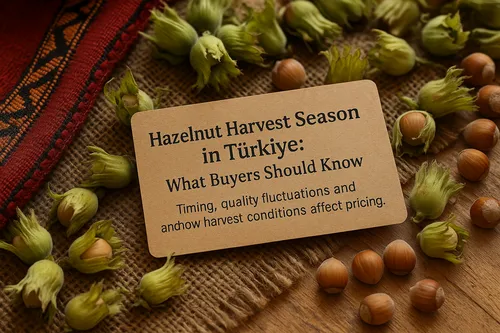
Hazelnut Harvest Season in Türkiye: What Buyers Should Know
Türkiye’s Black Sea region dominates global hazelnut production, and understanding the annual harvest cycle is essential for industrial buyers, importers and procurement teams. The timing of the harvest influences kernel moisture, defect rates, availability, pricing, and long-term contracting strategies.
1. When does the hazelnut harvest take place in Türkiye?
The Black Sea region, Türkiye’s primary hazelnut-growing zone, follows a predictable annual harvest timeline influenced by climate and regional elevation.
- Early August – Mid August: Mediterranean-facing low-altitude orchards.
- Late August – Early September: Central Black Sea region (major production areas).
- Mid September: Higher altitude orchards and late-ripening cultivars.
Most industrial hazelnut buyers consider August–October the core buying season for raw materials, which later move to cracking, sorting, blanching and export preparation.
2. Why drying conditions determine quality and moisture stability
Hazelnuts must be properly dried to achieve a stable moisture level before cracking and storage. Poor drying leads to mould, defects, and shorter shelf life.
Typical moisture targets
- In-shell moisture target: 6–7% before cracking
- Kernel moisture target: 3–5% after processing
Early-season nuts often have higher moisture and require more controlled drying, while later-season nuts naturally dry more easily due to favorable weather conditions.
3. How harvest timing affects kernel quality
Seasonal timing directly correlates with industrial quality parameters such as defect rates, skin adherence, kernel shrinkage and flavor development.
- Early harvest: Sometimes underdeveloped kernels, higher shrinkage risk.
- Peak-season harvest: Ideal maturity, optimal flavor and size distribution.
- Late harvest: Risk of over-drying and natural defects from weather exposure.
Tombul, Foşa and Çakıldak cultivars each react differently to seasonal conditions, meaning processors often adjust purchasing strategies based on predicted quality patterns.
4. How the harvest season affects hazelnut pricing
Hazelnut prices in Türkiye are strongly influenced by expectations surrounding the new crop. Industrial buyers track several key indicators:
- Estimated annual production: Lower yields typically increase prices.
- Climate impact: Frost, storms and humidity shape final output.
- Export demand: Global confectionery and chocolate markets drive competition.
- Government interventions: Türkiye occasionally stabilizes farmer prices via TMO.
Prices tend to stabilize 30–60 days after the harvest once processors finalize yield and kernel quality estimates.
5. Ideal procurement strategy during harvest season
Best practices for importers and manufacturers
- Secure early-season contracts for baseline volumes.
- Request new-crop samples immediately after cracking season starts.
- Verify moisture levels before confirming shipments.
- Use separate specifications for raw, roasted, chopped and paste formats.
- Plan shipments proactively because port congestion peaks after the new crop.
Long-term partners often allocate volume over several months to balance quality and price fluctuations.
6. Should buyers wait after the harvest before purchasing?
Some buyers prefer the first-crack period for maximum availability, while others wait until processors complete early-season cleaning and sorting.
- Immediate post-harvest purchasing: Larger availability, better price negotiation.
- Mid-season purchasing: More stable supply, clearer quality picture.
- Late-season purchasing: Suitable for non-urgent programs and big bag formats.
The optimal approach depends on your specific kernel format, roasting requirements, and contract structures.
Need guidance on new-crop hazelnut procurement?
We help manufacturers plan volumes, specifications, and shipment timelines based on Türkiye’s harvest cycle.