
Hazelnut Meal vs Hazelnut Flour: Technical Differences & Industrial Performance
Hazelnut meal and hazelnut flour are widely used in bakery, confectionery, spreads, cereals and plant-based formulations. Although often confused, they differ in granulation, oil content, processing methods and industrial performance. This guide explains how each behaves in dough systems, extrusion, gluten-free applications and fat-sensitive recipes.
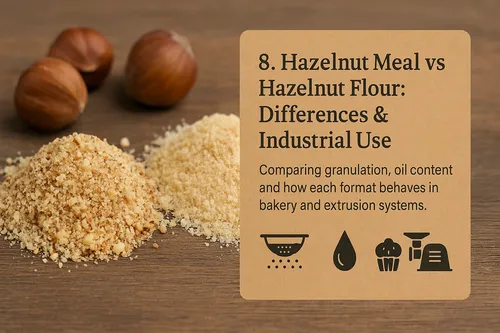
What is the difference between hazelnut meal and hazelnut flour?
Although both products come from roasted or raw hazelnuts, they serve different functional roles in food systems:
- Hazelnut meal: Coarser granulation, typically produced by grinding hazelnut kernels after chopping or roasting. Contains full natural oil content and visible particle structure.
- Hazelnut flour: More finely milled, uniform and powder-like. Designed for blending into dough systems, gluten-free bakery and nutritional formulations.
Understanding these differences allows manufacturers to optimize texture, spreadability, absorption, and fat interaction in finished products.
1. Granulation differences: the core functional distinction
Granulation affects texture, hydration and how the product behaves in industrial processing.
Typical granulation ranges
- Hazelnut meal: 1–3 mm coarse particles for toppings, inclusions and bakery doughs
- Fine meal: 0.5–1 mm for pastry and extrusion applications
- Hazelnut flour: ≤ 300 microns (powder-like), ideal for blending uniformly into mixtures
Fine flour increases homogeneity in dough systems and reduces grittiness in spreads and fillings.
2. Oil content & fat behavior
Both formats retain hazelnut’s natural fat (55–65% depending on variety). However, the surface area and particle size influence fat release:
- Meal retains more structure, leading to slower oil migration.
- Flour releases oil more readily, requiring careful formulation in low-fat systems.
In chocolate and praline systems, flour disperses faster, while meal provides texture.
3. Processing methods: raw, roasted & defatted variations
Hazelnut meal and flour can be produced in several ways depending on usage:
- Raw meal/flour: Lighter flavor, used in extrusion and nutritional products.
- Roasted meal/flour: Strong aroma for bakery, confectionery and fillings.
- Defatted flour (partially oil-reduced): Higher protein concentration, used in functional and high-protein products.
Defatted hazelnut flour is increasing in demand in plant-based applications.
4. Industrial applications & usage recommendations
Key application fields include:
- Gluten-free bakery: Hazelnut flour provides structure and flavor.
- Chocolate & praline: Meal used for texture; flour for smooth integration.
- Extruded snacks: Raw or partially defatted flour improves expansion control.
- Breakfast cereals & granola: Meal adds crunch and nut particulates.
- Plant-based drinks & nutrition: Fine flour improves solubility and flavor.
Manufacturers often use a blend of both meal and flour to balance texture and fat performance.
5. Choosing the right format for your process
The correct choice depends on your process and equipment:
- Choose meal when texture or visible nut particulates are desired.
- Choose flour for homogeneous mixing, especially in dough or batters.
- Choose defatted flour when the goal is protein enrichment or fat reduction.
For large-scale operations, consistency in granulation, oil percentage and microbiological profile is essential for repeatable performance.
Need hazelnut meal or flour for your production line?
Share your granulation target, oil preference and application type. We will prepare a tailored offer from Türkiye.