
Technical Properties of Hazelnut Oil
Hazelnut oil is valued for its unique flavor, oxidative stability and versatile functional properties across food, cosmetic and nutraceutical applications. This article provides a full technical breakdown of its fatty acid profile, performance characteristics, stability metrics and recommended industrial uses.
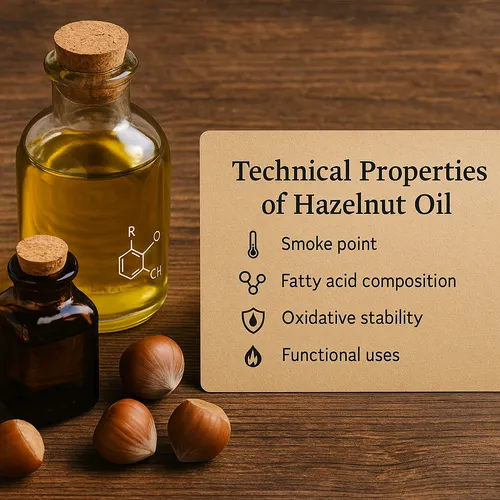
1. Overview of hazelnut oil as a food ingredient
Hazelnut oil is extracted from high-quality kernels, typically through cold pressing or solvent-free mechanical extraction. Its composition gives it a clean, nut-forward flavor, excellent oxidative performance, and versatility in chocolate, bakery, spreads and premium cooking oils. Refined hazelnut oil offers a neutral flavor for food applications requiring stability, while cold-pressed oil is prized for its aromatic profile.
2. Fatty acid composition
The fatty acid profile of hazelnut oil is similar to high-quality olive oil, dominated by monounsaturated fats, which contribute to its stability.
- Oleic acid (C18:1): 70–82% · major contributor to oxidative resistance
- Linoleic acid (C18:2): 8–16% · essential fatty acid
- Palmitic acid (C16:0): 4–7% · saturated fat component
- Stearic acid (C18:0): 1–3% · contributes to structure only minimally
This profile enables hazelnut oil to maintain flavor and color stability better than many other nut oils with higher polyunsaturated content.
3. Oxidative stability & shelf life
Oxidative stability is a key indicator for edible oils. Hazelnut oil performs well due to its high monounsaturated content.
- Peroxide value (PV): remains low when properly stored
- p-Anisidine value (AV): typically low, indicating low secondary oxidation
- Oxidative Stability Index (OSI): higher than almond or walnut oil
Shelf life depends on packaging, temperature and exposure to oxygen. Cold-pressed versions require more protective packaging (dark bottles or oxygen-barrier materials).
4. Smoke point & heat performance
Although hazelnut oil is not typically used for deep frying, it has a respectable smoke point:
- Cold-pressed: ~190°C (374°F)
- Refined: 220–230°C (428–446°F)
This enables refined hazelnut oil to function well in baking, sautéing and industrial heat-processing environments where stability is required.
5. Functional performance in food manufacturing
Hazelnut oil’s flavor profile and stability make it useful for multiple industrial formats.
Typical applications:
- Praline & spreads: enhances nut flavor and smooth texture
- Chocolate fillings: provides clean melt profile
- Baked goods: adds moisture and aromatic complexity
- Premium dressings: used for gourmet oils and emulsions
- Plant-based products: contributes richness in dairy-free innovations
The oil disperses well in fat matrices, making it suitable for creams, ganache systems and aerated fillings.
6. Cold-pressed vs refined: technical comparison
| Property | Cold-Pressed Hazelnut Oil | Refined Hazelnut Oil |
|---|---|---|
| Flavor profile | Strong hazelnut aroma, premium applications | Neutral, suitable for general food processing |
| Color | Golden to deep amber | Light yellow |
| Smoke point | Lower | Higher |
| Oxidative stability | Good, but sensitive to UV & oxygen | Very high |
| Applications | Premium oils, gourmet foods, cosmetics | Industrial foods, frying, bakery, cosmetics |
7. Technical quality parameters (typical)
- FFA (free fatty acids): ≤ 0.4–0.6% (refined), ≤ 1.0% (cold-pressed)
- Peroxide value: ≤ 10 meq O₂/kg (refined); varies for cold-pressed
- Moisture & volatiles: ≤ 0.2%
- Insoluble impurities: ≤ 0.05%
- Color (Lovibond): dependent on extraction type
8. Storage, packaging & stability recommendations
Proper storage preserves both aroma and oxidative stability.
- Store at 10–20°C in a cool, dry environment
- Avoid direct sunlight and oxygen exposure
- Use nitrogen-flushed containers if possible
- Refined oil offers longer shelf life for export logistics
Looking for bulk hazelnut oil supply?
We offer cold-pressed and refined hazelnut oils with full specifications, export documentation and tailored packaging options.