
Overview of Hazelnut Processing Equipment
Modern hazelnut processing relies on advanced machinery to crack, clean, sort, calibrate, blanch, roast and pack hazelnuts at industrial scale. This article provides a detailed breakdown of the equipment used in professional processing lines from raw in-shell nuts to export-ready kernels.
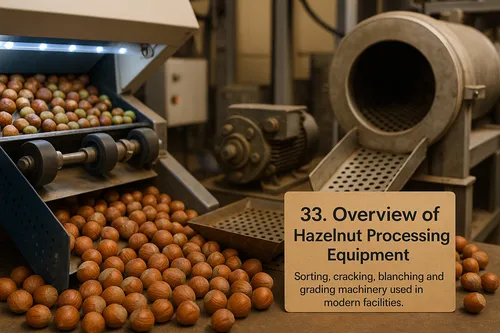
1. Introduction to hazelnut processing equipment
After harvesting and drying, hazelnuts enter industrial facilities where mechanical and optical technologies ensure the nuts meet strict food industry specifications. Processing equipment is designed to:
- Remove foreign materials
- Crack shells efficiently with high yield
- Grade kernels by size and quality
- Remove defects and off-colors
- Roast, blanch or further process nuts according to customer formats
- Pack and protect kernels for export
The choice of machinery depends on capacity requirements, product formats, and quality control standards expected by global buyers, especially those in chocolate, bakery and plant-based industries.
2. Cleaning & pre-processing equipment
Before cracking, hazelnuts pass through several cleaning stages to remove debris and ensure safe handling.
Common equipment includes:
- Air separators: remove lightweight materials such as leaves and dust.
- Vibratory sieves: filter out stones, soil, small shells and undersized nuts.
- Magnetic traps: capture ferrous particles for food safety compliance.
- Stone separators: ensure removal of hard objects that may damage cracking machinery.
Proper pre-cleaning is critical to protecting downstream equipment and maintaining product integrity.
3. Hazelnut cracking systems
Cracking is a pivotal stage where the shell is mechanically broken without damaging the kernel. Processing facilities typically use:
- Impact crackers · for high-speed cracking of large volumes
- Roller-based cracking machines · control pressure to minimize kernel breakage
- Precision sheller systems · adaptable to regional hazelnut varieties
Yield optimization (percentage of whole kernels) is directly influenced by the cracking technology and calibration.
4. Kernel-shell separation equipment
After cracking, facilities separate shells and kernels through air and mechanical systems.
Typical technologies include:
- Aspiration channels: blow away lighter shell fragments.
- Gravity separators: differentiate kernels from shells by density.
- Rotary drum classifiers: ensure accurate separation for further sorting.
Effective shell removal reduces downstream contamination and improves the accuracy of optical sorting systems.
5. Optical sorters & defect removal technologies
Optical sorting is one of the most advanced areas of hazelnut processing, ensuring only compliant kernels progress to packaging or roasting.
- Camera-based sorters: identify color deviations, mould, stains and dark kernels.
- NIR (near-infrared) sorters: detect internal defects and foreign matter.
- X-ray systems: used in high-specification applications where extra safety is required.
These systems significantly improve quality, reduce manual labor and enhance food safety for export markets.
6. Calibration & size grading machinery
Kernels are graded by size — typically 9–11 mm, 11–13 mm, 13–15 mm, and 15+ mm — using mechanical calibration systems.
- Rotary screen graders: separate kernels by diameter.
- Vibratory size graders: provide precision for premium chocolate grades.
- Multi-stage calibration lines: used in high-capacity export facilities.
Accurate calibration ensures consistent roasting performance and uniformity in finished products.
7. Roasting & blanching equipment
Many manufacturers purchase hazelnuts roasted or blanched, and industrial processors use specialized systems to achieve the required flavor and texture.
Roasting equipment:
- Continuous roasters: ideal for large-volume, steady output.
- Batch roasters: used for premium or specialty roasting profiles.
- Hot-air convection systems: ensure uniform heat penetration.
Blanching equipment:
- Thermal blanchers: heat kernels to loosen skin for mechanical removal.
- Mechanical peelers: remove skins through abrasion or airflow.
- Integrated roast-blanch lines: combine both processes efficiently.
8. Final sorting, quality control & packing equipment
Before export, hazelnuts undergo final sorting and packing to meet buyer specifications.
- Manual sorting conveyors: human oversight for final visual inspection.
- Metal detectors: mandatory for export food safety compliance.
- Automated weighing & bagging systems: fill 25 kg, 50 kg or big bags.
- Vacuum sealing systems: preserve freshness during long sea freight.
Combined with documentation and batch coding, these systems prepare product for global food manufacturing customers.
9. Trends in processing automation & digitalization
Leading processors invest in automation to improve efficiency and quality. Key trends include:
- IoT-based monitoring of roasting and sorting equipment
- Automated data collection for traceability and QA audits
- Energy-efficient motors and heating systems
- AI-enhanced optical sorting for defect prediction
These upgrades improve consistency and provide buyers with more reliable specifications.
Need hazelnuts processed with advanced equipment?
We work with certified processors using modern cracking, sorting, roasting and packing technologies for premium product consistency.