
Roasting Profiles for Hazelnuts: Light, Medium & Dark
Roasting is one of the most critical steps in hazelnut processing, transforming raw kernels through heat-induced flavor development, moisture reduction and textural refinement. This guide explains industrial roasting profiles—including light, medium and dark roasts—and how each profile influences aroma, crunch, color, oil behavior and suitability for various product categories.
1. Why roasting matters in hazelnut processing
Roasting triggers chemical reactions—most notably Maillard reactions and lipid oxidation—that create the characteristic hazelnut aroma recognized by consumers worldwide. It also improves crunch, removes residual moisture and enables skin separation in blanched formats.
Key roasting objectives
- Developing flavor and aroma through Maillard reactions.
- Reducing moisture from 3–5% to as low as 1–2%.
- Enhancing texture and structural stability.
- Facilitating skin removal (blanching efficiency).
- Improving shelf-life through moisture and microbial reduction.
2. Light roast profile
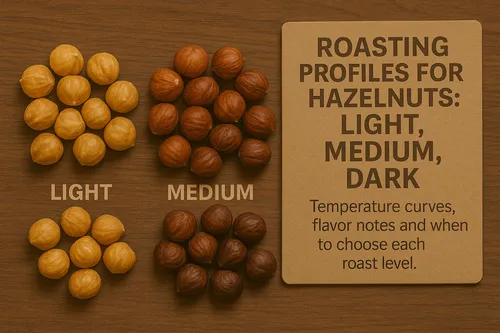
Light roasting preserves the natural flavor of hazelnuts while slightly boosting aroma. Kernels remain pale with a softer crunch compared to medium and dark roasts.
Typical sensory characteristics
- Mild, buttery flavor with subtle sweetness.
- Light golden color.
- Moderate skin removal efficiency.
- Slightly softer bite, suited for gentle applications.
Industrial applications
- Premium chocolate products where nuts are coated or enrobed.
- Blended hazelnut pastes requiring delicate flavor.
- Baked goods needing light nut character without dominance.
3. Medium roast profile
Medium roasting is the industry’s most widely used profile. It maximizes overall sensory balance—aroma intensity, crunch, color and flavor complexity—without risk of burnt notes.
Typical sensory characteristics
- Rich hazelnut aroma with caramelized notes.
- Higher crunch level due to moisture reduction.
- Golden-brown color ideal for visual inclusions.
Industrial applications
- Confectionery and pralines.
- Cereal and granola clusters.
- Chopped hazelnuts for toppings and bakery mixes.
- Nut butters and premium spreads.
Why manufacturers prefer medium roast
- Balances flavor intensity with versatility.
- Maintains kernel integrity during mechanical handling.
- Produces minimal off-notes in downstream processing.
4. Dark roast profile
Dark roasting produces a robust, intense flavor profile with more pronounced caramelization and a deeper, crunchier texture. It is favored in applications requiring bold hazelnut character.
Typical sensory characteristics
- Deep, toasty flavor with strong aromatic intensity.
- Maximum crunch and low moisture content.
- Dark golden-brown to deep brown color.
Industrial applications
- Gelato and ice cream bases (praline + roasted notes).
- High-intensity spreads and nut pastes.
- Visible inclusions in chocolate that require strong flavor contrast.
- Snack mixes where bold flavor is desired.
5. How manufacturers choose the right roasting profile
Roasting decisions depend on product category, process steps, downstream thermal exposure and intended consumer experience.
Key selection factors
- Product type — chocolate needs different profiles than gelato or snack mixes.
- Texture requirements — softer vs. crunchy inclusions.
- Flavor intensity — delicate vs. bold consumer expectation.
- Processing steps — additional baking or refining can deepen roast notes.
Examples
- Chocolate tablets → medium roast for balanced aroma.
- Premium praline → medium–dark roast for flavor richness.
- Cereal clusters → medium roast for crunch retention.
- Gelato → dark roast paste for maximum flavor strength.
6. Industrial roasting parameters & equipment
Hazelnuts are roasted using either batch ovens or continuous roasting lines. Each system allows processors to precisely control temperature, airflow and dwell time.
Typical industrial parameters
- Roast temperature: 120–170°C depending on profile.
- Dwell time: 12–40 minutes depending on machine type.
- Target moisture after roasting: 1–2%.
- Airflow controls for uniform heat transfer.
Equipment types
- Continuous roasters — highest consistency and throughput.
- Batch roasters — flexible for specialty profiles.
- Infrared roasters — rapid heating with reduced energy use.
Need roasted hazelnuts matched to your specification?
We supply calibrated, roasted kernels in light, medium and dark profiles for industrial use.