
Traceability & Export Standards in Turkish Hazelnuts
Traceability and export compliance are critical pillars of Türkiye’s hazelnut industry. International buyers rely on transparent supply chains, documented production practices, and rigorous testing protocols to meet EU, US, Asian and global import standards. This guide explains the full traceability system, export documentation, quality audits, aflatoxin control programs, and certification schemes used by Turkish processors.
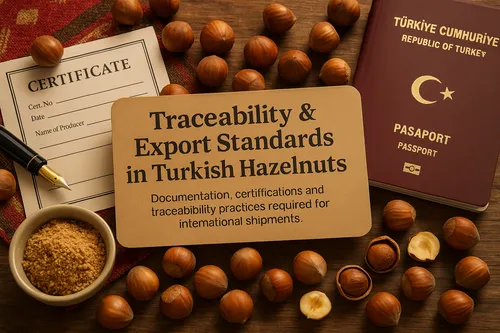
1. Why traceability matters in the hazelnut supply chain
Food manufacturers and importers require full visibility into where hazelnuts originate, how they are processed, and whether lots meet legal and contractual safety standards. Traceability ensures:
- Control over raw material quality and safety
- Compliance with international import laws
- Verification of sustainability or ethical sourcing claims
- Rapid recall or batch investigation if required
Turkish processors maintain traceability records from orchard to export container, enabling end-to-end tracking for each batch.
2. How traceability works in Türkiye’s hazelnut industry
The traceability process begins at the farm level and continues through cracking, sorting, roasting, paste production and packing.
Key traceability checkpoints
- Farm origin: orchard location, grower information, harvest date
- Drying stage: moisture confirmation and contaminant control
- Cracking facilities: cleaning, shell removal, optical sorting
- Batch coding: unique identifier assigned before kernel calibration
- Processing line data: roasting logs, metal detection, packaging records
- Final packing: batch code + production date + lot-specific documents
Every exportable lot receives a traceability file that buyers can request during audits or technical evaluations.
3. Certification and quality management systems
Leading Turkish hazelnut processors operate under internationally recognized food safety schemes. These certifications validate process control, hygiene systems, and hazard management at every production stage.
Common certifications held by export-approved processors
- BRCGS Food Safety (widely used in confectionery supply chains)
- IFS Food
- ISO 22000 / HACCP-based food safety systems
- Organic certifications for selected programs
Certification reviews are typically performed annually and include detailed factory audits, equipment checks, sanitation assessments, allergen control programs and traceability trials.
4. Key export documents for hazelnuts
Each hazelnut shipment from Türkiye must be supported by a standard set of export documents used by customs, quality teams and buyers.
Standard documents
- Commercial invoice — product, quantity, grade and pricing
- Packing list — bag count, net/gross weight
- Certificate of Origin — proving Turkish origin
- Phytosanitary certificate — confirming plant health compliance
- Health certificate — issued by agricultural authorities
- Aflatoxin analysis report — provided on request or required for EU
- SGS / third-party inspection report — optional but common
Buyers in the EU, USA, China and Middle East often require additional documentation based on their own regulations.
5. Aflatoxin control programs in export channels
Aflatoxin is one of the most strictly monitored hazards in hazelnut exports. Turkish processors follow multi-layered screening protocols to ensure compliance with local and international limits.
Control methods
- Pre-harvest orchard monitoring
- Visual and optical defect removal
- Sorting based on density and color deviations
- Sampling and laboratory testing (ELISA / HPLC methods)
- Mandatory government testing for certain export destinations
Each batch can be accompanied by verified aflatoxin test reports when necessary.
6. Batch coding, lot segmentation & product recall capability
Processors assign batch codes that allow manufacturers to trace each lot back to specific processing days, lines and raw material sources. This system provides:
- Isolation of suspect material during investigations
- Efficient recall processes if deviations occur
- Stronger verification for auditors and regulators
- Full documentation for private label and branded programs
Many large buyers perform mock recall audits to verify supplier performance.
7. Compliance differences by destination market
Each global region applies its own regulatory framework for nut imports. Turkish exporters adapt documentation and processes accordingly.
- EU: strict aflatoxin limits, high traceability expectations
- USA: FDA compliance, FSMA requirements, preventive controls
- Middle East: certificates of conformity, halal certification in some markets
- China: CIQ inspections and reinforced entry testing
8. What buyers should request from their supplier
- Batch-specific traceability file
- Certificates (BRC, IFS, ISO 22000)
- Aflatoxin test results
- Processing flowchart & HACCP details
- Specification sheets for each format
- Photos of processing stages if required for audits
Clear traceability and documentation significantly reduce operational risks and improve quality assurance performance for manufacturers.
Need traceable, export-ready hazelnut supply?
Share your requirements and we will prepare a compliant, fully documented offer for your market.