
Industrial Quality Requirements for Praline & Hazelnut Paste Production
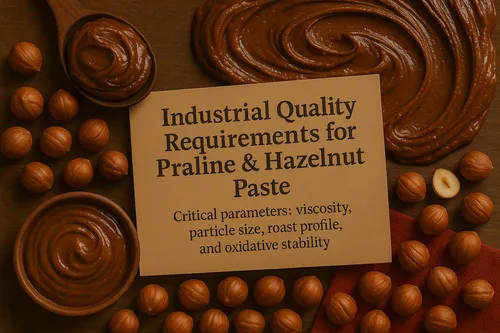
Praline and hazelnut paste are essential ingredients in chocolates, fillings, spreads, gelato, bakery items and plant-based formulations. Industrial buyers must evaluate several technical parameters—including particle size, viscosity, roast profile, oxidative stability and microbiological quality—to ensure consistent performance in large-scale production.
1. What defines industrial-grade hazelnut paste?
Hazelnut paste (100% hazelnut) and praline (typically hazelnut + sugar) must meet precise specifications for machinery compatibility, shelf life, flavor stability and viscosity. Variability can lead to equipment blockages, separation, inconsistent texture and reduced flavor performance in finished products.
Industrial hazelnut paste properties
- 100% ground hazelnuts, usually lightly or medium roasted.
- Particle size typically between 12–25 microns after refining.
- Consistent viscosity for pumping and dosing systems.
- Stable fat phase with controlled oxidation parameters.
- Free from contaminants, with tight microbiological limits.
2. Particle size distribution (PSD) & refining consistency
PSD is one of the most important quality parameters in praline and paste manufacturing. It affects flow behavior, mouthfeel, emulsification and stability in filling systems.
Target PSD ranges by application
- Chocolate fillings: 15–22 microns for smooth texture.
- Spreads and creams: 12–18 microns for uniform flavor release.
- Frozen desserts (gelato): 20–25 microns to prevent over-viscosity.
- Plant-based drinks / emulsions: fine PSD enhances dispersion.
A coarse PSD may produce a grainy texture, while excessive fineness may cause unexpected oil release or system over-thickening. Refining method (stone mill, ball mill, five-roll refiner) determines PSD consistency.
3. Roast level & flavor development for praline systems
Roasting drives more than flavor—it impacts oil viscosity, Maillard reaction products, color intensity and the oxidative stability of the final paste.
Preferred roast levels in industrial applications
- Light roast: Used for delicate pralines and milk chocolate fillings.
- Medium roast: Most common for pâtisserie, gelato and spreads.
- Dark roast: Limited use; may overpower other ingredients.
A uniform roast ensures predictable viscosity behavior during milling and refining. Variability in roast level can cause differences in color and fluidity from batch to batch.
4. Oil behavior, oxidative stability & shelf-life controls
Hazelnuts naturally contain 55–65% oil, making oxidation control essential for stable praline and paste production. Proper handling ensures long-lasting flavor and prevents rancidity.
Key chemical indicators
- Peroxide value (PV): Indicates oxidative progress—lower is better.
- Free fatty acids (FFA): Higher levels may indicate degradation.
- Totox value: Combined indicator of total oxidation stress.
How processors maintain stability
- Use of fresh, low-moisture, calibrated kernels.
- Refining under controlled temperatures.
- Rapid cooling post-roast to prevent burn-off or overreaction.
- Oxygen control during packing (vacuum or nitrogen flush).
- Use of food-safe antioxidants when required.
Shelf life typically ranges between 6–12 months depending on packaging and roast profile. Export destinations with warm climates require tighter stability targets.
5. Viscosity, pumpability & equipment compatibility
In modern factories, praline and hazelnut paste often move through pumping, dosing, injection and enrobing systems. Therefore, viscosity must be predictable.
Viscosity factors
- Roast level influences oil fluidity.
- Particle size distribution affects flow resistance.
- Shear history during milling impacts final texture.
- Temperature during application significantly alters viscosity.
Manufacturers frequently request viscosity targets under specific shear conditions (e.g., Brookfield spindle measurements) to ensure compatibility with their lines.
6. Microbiological standards & food safety requirements
As a high-fat, low-moisture product, hazelnut paste has relatively low microbial risk. However, strict compliance is required for export and certification-driven buyers.
Typical microbiological limits
- Salmonella: absent in 25g.
- Yeasts & moulds: controlled via roasting and hygienic handling.
- Total plate count (TPC): typically low due to high roasting temperatures.
Processors must maintain validated roasting, metal detection, sieving, and allergen management programs to meet global food safety standards (often GFSI-aligned).
7. Packaging & export considerations for industrial paste
Bulk praline and hazelnut paste shipments use packaging formats designed to protect from oxygen and temperature fluctuations during long-distance transport.
Common packaging options
- 10–25 kg buckets with sealed lids.
- Vacuum-packed bags for premium paste.
- Cartons or big bags for industrial buyers using continuous systems.
Many buyers specify max storage temperatures (10–18°C) and require chilled transport for long hauls, especially for delicate pralines.
8. Buyer specification checklist
A well-prepared specification prevents inconsistencies and supports smooth long-term supply programs.
- PSD target (micron range)
- Roast level and color parameters
- Viscosity profile under specified conditions
- Oxidation limits: PV, FFA, Totox
- Microbiological guidelines
- Packaging type and palletization
- Application details (spread, filling, chocolate use, gelato, etc.)
Need industrial-grade praline or hazelnut paste?
Share your PSD, roast level and viscosity requirements. We will prepare a tailored quote from Türkiye.