
Preparing Hazelnuts for Export: QA & Packing Protocols
Export-ready hazelnuts must meet strict global standards for quality, safety, moisture, uniformity, documentation and stability during long-distance transport. This guide explains how processors prepare raw, blanched, roasted, chopped, paste and in-shell hazelnuts for compliant export to Europe, the Middle East, Asia and the Americas.
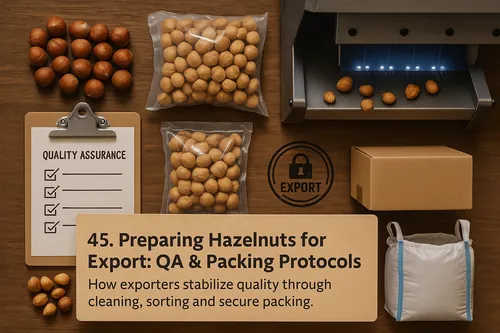
1. The objectives of export preparation
Preparing hazelnuts for export ensures:
- Compliance with food safety and phytosanitary regulations.
- Physical stability during sea or land transit.
- Consistent product quality across all bags, pallets and containers.
- Reduced risk of moisture increase, infestation or oxidation.
- Documentation accuracy for customs, authorities and destination QA teams.
Different product formats — kernels, roasted, chopped, meal, flour, paste, oil or in-shell — require tailored preparation, but follow the same principles of cleanliness, uniformity and regulatory alignment.
2. Pre-export cleaning & sorting
Before packing, hazelnuts pass through multiple cleaning and sorting stages to ensure they meet quality tolerances agreed with the buyer:
▶ Mechanical cleaning
- Removal of shells, stones, sticks and heavy foreign matter.
- Air separation to remove light impurities such as dust or skin fragments.
▶ Optical sorting
- Color-based rejection of dark, moldy or severely stained kernels.
- NIR (near-infrared) detection for internal defects in premium lots.
▶ Manual belt inspection
- Final check for shriveled kernels, insect damage and off-colors.
- Critical for chocolate-grade whole kernels.
3. Moisture stabilization & quality verification
Moisture must be controlled before hazelnuts are sealed for long-distance shipping.
Moisture targets
- Raw kernels: typically 3–5%
- Roasted kernels: 1.5–2.5%
- In-shell: 9–12% (varies by region and buyer tolerance)
High moisture increases the risk of mold, rancidity and oxidation during transit, especially in warm climate shipping routes.
Typical quality checks before packing
- Defect count (shriveled, damaged, stained, moldy).
- FFA (free fatty acids) and peroxide values for paste and oil.
- Aflatoxin testing according to EU and FDA standards.
- Microbiological testing depending on buyer requirements.
4. Packing formats used for export
The choice of packaging depends on product format, shelf life needs, destination climate and handling requirements.
▶ Vacuum bags (most common for kernels)
- Typically 25 kg vacuum-sealed bags.
- Prevents oxidation and moisture ingress.
- Ideal for long sea freight to Asia or the Americas.
▶ Polypropylene (PP) bags
- Used in markets where vacuum is not mandatory.
- Cost-effective and durable.
▶ Big bags (500–1000 kg)
- Used for industrial processors who rework or crack hazelnuts further.
▶ Carton-lined or double-layered bags
- Used for sensitive formats like meal, flour and paste.
- Prevents oil migration and clumping.
5. Palletization & container loading
How hazelnuts are loaded into containers plays a major role in product stability and quality upon arrival.
Palletization
- Heat-treated or fumigated pallets required for international shipments.
- Stretch-wrapping protects against humidity and shifting.
- Corner supports prevent bag deformation.
Container selection
- Standard 20’ & 40’ containers for kernels and paste.
- Refrigerated containers occasionally used for premium paste or long routes.
- Ventilation recommendations based on ambient climate.
Loading best practices
- Desiccant bags installed to reduce humidity fluctuations.
- Avoid loading during rainfall or high humidity.
- Seal container with a numbered bolt seal for traceability.
6. Documentation required for export
Export documentation ensures regulatory compliance and smooth customs clearance.
- Commercial invoice with product, HS code and Incoterms.
- Packing list detailing bags, pallets and weights.
- Certificate of Origin (Chamber of Commerce).
- Phytosanitary certificate (for kernels or in-shell).
- Health certificate confirming compliance with food safety standards.
- Aflatoxin test reports on request.
- Bill of Lading from the shipping line.
- Insurance certificate for CIF shipments.
7. Export checklist for importers & manufacturers
- Required product format (raw, roasted, blanched, chopped, meal, paste, in-shell).
- Exact moisture and defect tolerances.
- Preferred packing method (vacuum, PP, big bag).
- Destination port and Incoterms (FOB, CFR, CIF, DAP).
- Documentation requirements and testing plans.
- Loading schedule and seasonal supply planning.
Need export-ready hazelnuts for your market?
Atlas Hazelnuts supplies fully compliant, quality-controlled export programs worldwide.