
Product Development with Hazelnut Ingredients
Hazelnuts are one of the world’s most versatile premium ingredients, used across chocolate, bakery, snacks, beverages, plant-based concepts and nutritional products. This guide explains how food manufacturers can leverage kernels, pastes, oils, chopped formats and powders to create high-performing, commercially successful products.
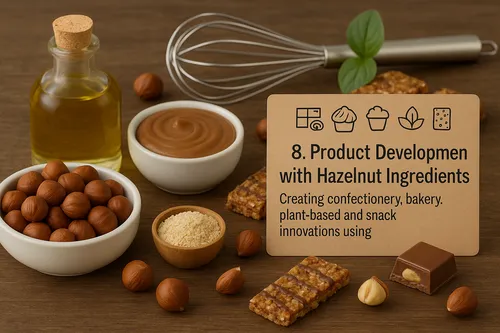
1. Why hazelnuts are a powerful product development ingredient
Hazelnuts combine clean label appeal, a naturally rich aroma, high oil content, and a premium consumer perception. For formulators, they offer multiple functional benefits:
- Strong consumer association with chocolate indulgence and premium bakery
- High oxidative stability compared to many nuts
- Versatile forms — whole, roasted, chopped, sliced, meal, flour, paste, praline, oil
- Compatibility with cocoa, dairy, grains and plant-based matrices
- Natural nutritional benefits (healthy fats, vitamins, minerals)
These properties make hazelnuts suitable not only for traditional applications but also for modern, health-forward, and plant-based innovation pipelines.
2. Chocolate & confectionery: enhancing flavor, texture and visual appeal
Hazelnuts are deeply embedded in the chocolate industry. Their flavor compounds pair naturally with cocoa, dairy and sugar systems, making them ideal for both inclusion and filling applications.
Recommended hazelnut formats
- Whole kernels – visual inclusions in premium bars & pralines
- Roasted chopped kernels – texture for bars, toppings, brittle & clusters
- Hazelnut paste (100%) – base for pralines, spreads, fillings
- Hazelnut oil – boosts aroma in fine chocolate applications
Key formulation considerations
- Caliber selection strongly affects the visual profile of whole-nut chocolate.
- Paste viscosity depends on roast level, oil migration and particle size distribution.
- Roasting degree shapes flavor intensity and compatibility with cocoa ratios.
- Stability in chocolate requires moisture control and minimized defect levels.
3. Bakery & pastry applications
Hazelnuts contribute texture, flavor and nutritional value to bakery systems while providing premium differentiation.
Common bakery formats
- Chopped kernels – cookies, muffins, croissants, cakes
- Meal & flour – gluten-free recipes, sponges, tarts, biscuits
- Pastes – fillings, creams, mousses, spreads
Formulation insights
- Hazelnut meal increases richness but requires moisture adjustment in dough.
- Hazelnut flour provides fine crumb structure in gluten-free systems.
- Pastes combine well with cocoa, dairy fats and emulsifiers for stable fillings.
4. Plant-based innovation & nutritional concepts
As plant-based and clean-label categories grow, hazelnut ingredients provide natural flavor, functional fats, and nutritional value.
Applications
- Nut milks & plant-based beverages – hazelnut’s aromatic profile enhances flavor without added flavors.
- Protein bars / energy snacks – paste binds ingredients while adding natural sweetness.
- Vegan desserts & gelato – hazelnut paste provides creaminess and depth.
- Functional spreads – blends with cocoa, dates, proteins or alternative sweeteners.
R&D points to consider
- Oil separation in plant-based matrices requires emulsifier or stabilizer selection.
- Particle size impacts beverage stability and mouthfeel.
- Hazelnut flavor intensity depends on roast level and origin.
5. Snacks, cereals & ready-to-eat applications
Hazelnuts are increasingly used in premium snacking and cereal segments, supporting “better ingredients, better nutrition” positioning.
- Roasted kernels – flavored snacks, nut mixes, coated snacks
- Chopped formats – granola, muesli, clusters, toppings
- Flours – protein-enriched blends and baked snack bases
Stability during high-temperature or high-oxygen processing is essential; hazelnuts’ naturally stable lipids often outperform walnuts, pecans or some seeds in these categories.
6. How to select the right hazelnut format for your product
Matching the correct format to the intended product is the key to success in formulation.
- Choose kernels when you need visual impact or crunch.
- Choose chopped for texture without large inclusions.
- Choose paste for flavor integration and creamy structures.
- Choose meal/flour for structure, binding and gluten-free recipes.
- Choose oil for flavor enhancement or lipid phase tuning.
Most manufacturers use multiple formats across the same product line to fine-tune cost, performance and flavor intensity.
7. Working with suppliers during product development
Close collaboration with a hazelnut supplier is essential to achieving consistent quality and predictable industrial performance.
- Request samples across multiple calibers and roast profiles.
- Share processing conditions (roaster type, temperature curve, moisture allowances).
- Discuss long-term volume planning for price and supply stability.
- Align on defect tolerances, microbiological expectations and packaging needs.
Turkish origin offers strong availability, traceable supply lines, and a full range of industrial hazelnut formats — ideal for R&D teams building new product concepts.
8. Summary
Whether you are designing a premium chocolate inclusion, a clean-label plant-based beverage, a high-protein snack, or a gluten-free bakery item, hazelnuts offer a unique combination of flavor, functionality and consumer appeal. Selecting the right format — and working closely with a capable supplier — ensures optimum performance in commercial-scale manufacturing.
Developing a new hazelnut-based product?
Share your formulation goals, volume expectations and preferred formats. We support R&D teams worldwide.