
Rainforest Alliance Certified Hazelnuts
Rainforest Alliance certification promotes sustainable agriculture, biodiversity, ethical labor practices and traceable supply chains. For hazelnut buyers, it offers a verified sustainability framework aligned with brand commitments, retailer requirements and consumer expectations for responsibly sourced ingredients.
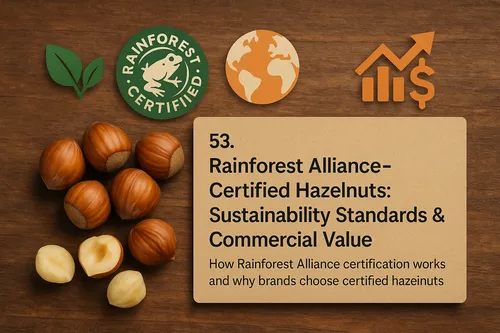
1. What Rainforest Alliance certification means for hazelnuts
Rainforest Alliance certification is designed to improve environmental, economic and social conditions across agricultural supply chains. For hazelnuts, certification supports responsible farming practices, protects ecosystems and promotes ethical working conditions.
Brands increasingly seek certified hazelnut ingredients to meet sustainability commitments and retailer requirements, especially in Europe and North America.
2. Core sustainability principles
The certification standard is built on four main pillars of responsible production:
- Environmental protection: Reduced pesticide use, soil health management, biodiversity conservation and erosion control.
- Social responsibility: Worker welfare, fair labor conditions and safe working environments.
- Livelihood improvement: Supporting smallholder farmers through training programs, yield optimization and market access.
- Climate resilience: Encouraging climate-smart farming practices.
3. Certification requirements for hazelnut orchards & processors
Hazelnut growers and processors must meet strict criteria to earn and maintain Rainforest Alliance certification.
Key requirements include:
- Responsible pesticide and fertilizer management
- Protection of waterways, soil and biodiversity areas
- Fair treatment and safe working conditions for farmers and employees
- Documentation of supply-chain practices and environmental controls
- Traceability systems ensuring certified product integrity
- Regular third-party audits
4. Traceability & chain-of-custody for certified hazelnuts
To maintain certification validity, certified hazelnuts must be clearly identifiable and traceable at every stage of the supply chain.
Typical traceability requirements
- Segregation of certified and non-certified hazelnuts
- Batch-level documentation from orchard to processing line
- Digital traceability logs used during audits
- Verification of volume matching (no over-claiming certified output)
Industrial buyers increasingly rely on certified traceability to meet reporting standards and sustainability disclosure requirements.
5. Why manufacturers choose Rainforest Alliance certified hazelnuts
For product developers and procurement teams, certification offers measurable advantages.
- Brand differentiation: Certified ingredients support sustainability-driven marketing and clean-label positioning.
- Retail compliance: Some retailers require verified responsible sourcing.
- Supply-chain transparency: Certification provides credible environmental and social assurance.
- Improved farmer livelihoods: Supporting responsible agriculture helps stabilize long-term supply.
6. How certification aligns with organic programs
Rainforest Alliance is not a substitute for organic certification — but both systems complement each other. Many buyers choose dual-certified hazelnuts to meet both sustainability and organic ingredient requirements.
Differences & synergies
- Organic: Focuses on inputs and farming methods (no synthetic pesticides, fertilizers or GMOs).
- Rainforest Alliance: Focuses on environmental, social and economic practices.
- Together, they support stronger ESG reporting and clean-label formulation.
Looking for Rainforest Alliance certified hazelnuts?
Atlas Hazelnuts supplies responsibly sourced hazelnut kernels, paste, flour and oil for global manufacturers.