
Industrial Guide to Roasted Hazelnuts: Applications, Roast Profiles & Quality Factors
Roasted hazelnuts play a critical role in chocolate, snacking, pastry and cereal manufacturing. This guide explores industrial roasting profiles, flavor development, defect behavior, sizing, quality parameters and sourcing considerations for global buyers and processors.
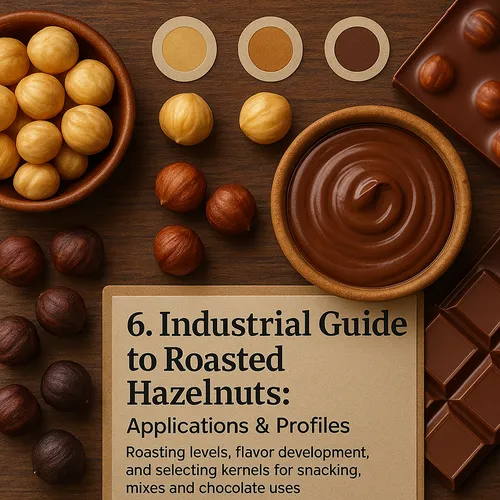
Understanding industrial roasting of hazelnuts
Roasting is a transformative step that defines the flavor, aroma, color and texture of hazelnuts. Whether used in chocolate bars, pralines, nut mixes, pastes or bakery toppings, the roast profile directly influences the sensory quality and functional performance of the final product.
Industrial roasting requires calibration, moisture control, consistent heat transfer, and careful defect management to achieve uniform quality at scale.
1. Light, medium and dark roast profiles
Manufacturers typically classify roasted hazelnuts into three main profiles, each suited to different product categories:
- Light roast: mild nutty flavor, lighter color, higher moisture retention. Common in premium chocolate inclusions where the natural flavor must remain clean.
- Medium roast: balanced flavor development, deeper aroma and improved crunch. Ideal for chocolate bars, pralines, spreads and mixed nut products.
- Dark roast: intense caramelization, deep brown color and robust aroma. Often used in coffee-style flavor systems, gelato, pralines and bakery fillings.
A standardized scale such as L-value (color measurement) is frequently used to ensure consistency across batches and production seasons.
2. How roasting develops flavor and aroma
Roasting triggers Maillard reactions and caramelization, transforming raw hazelnuts into a complex sensory ingredient. Key factors influencing flavor include:
- Initial moisture: controls internal steam pressure and final crunch.
- Kernel size: larger kernels require longer or hotter roasting curves.
- Roasting curve: gradual vs rapid heat ramps affect flavor depth and nutty aroma.
- Airflow and circulation: influence uniformity and heat penetration.
Turkish varieties such as Tombul are prized for their high oil content, producing richer flavor during roasting compared to lower-oil cultivars.
3. How defects behave during roasting
Roasting amplifies existing defects, making pre-roast quality control essential. Defects may:
- Stain or mold: become more visible and darken after roast.
- Shriveled kernels: roast faster and may over-darken.
- Damaged kernels: become brittle and break in handling.
- Internal mold: may only appear after roasting.
For this reason, optical sorting, manual inspection and density separation are indispensable for ensuring high-quality roasted outputs.
4. Importance of size calibration before roasting
Uniform roasting requires kernels of similar size, moisture and density. Typical calibrated sizes include:
- 11–13 mm · widely used in chocolate and roasting applications
- 13–15 mm · premium inclusions for bars and pralines
- 15+ mm · specialty and retail-grade roasted formats
Mixed sizes result in inconsistent color and flavor gradients, making calibration a critical prerequisite for industrial roasting lines.
5. Applications for roasted hazelnuts in food manufacturing
- Chocolate & pralines: whole-kernel inclusions, dragée products, praline filling inputs.
- Nut mixes & snacks: salted, spiced or flavored roasted hazelnuts.
- Bakery & pastry: toppings, fillings, chopped roasted inclusions.
- Cereals & granola: crunchy roasted kernels or chopped roasted formats.
- Ice cream & gelato: roasted hazelnut pieces or roasted-paste ingredients.
Many manufacturers also use roasted kernels as an intermediate for chopping, slicing, paste production and oil extraction.
6. Quality parameters buyers should request
Industrial purchasers typically define:
- Roast level and color target (L-value or internal scale).
- Maximum defect tolerance for dark kernels, scorched areas and broken pieces.
- Calibration / size grade to ensure even roasting.
- Moisture target (typically 1.5–2.5% after roasting).
- Origin & cultivar specification if flavor consistency is essential.
Documentation may include roasting charts, calibration certificates and pre-shipment photos.
7. Sourcing & export considerations
Roasted hazelnuts are generally supplied vacuum-packed to preserve freshness and slow oxidation. Buyers typically request:
- 25 kg vacuum bags · industry standard
- Carton or palletized packing for logistics stability
- COA including moisture, defect levels and aflatoxin test
- FOB or CFR terms depending on destination
When aligned with correct specifications, roasted hazelnuts become a consistent and high-value ingredient for industrial food manufacturing worldwide.
Looking for roasted hazelnuts for your production line?
Share your required roast profile, calibration and destination port. We’ll prepare a tailored industrial offer.