
Export Guide: Shipping Hazelnuts from Türkiye
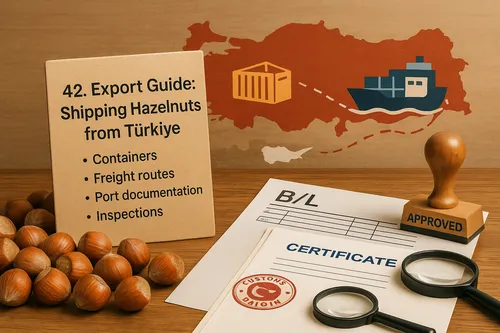
Türkiye is the world’s leading exporter of hazelnuts, supplying confectionery, bakery, chocolate, snacking and food manufacturing industries across more than 100 countries. This export guide explains how hazelnuts move from processing plants to international buyers, including documentation, container loading, logistics, inspections and regulatory requirements.
1. Türkiye’s role in global hazelnut exports
Türkiye accounts for approximately 60–70% of global hazelnut production and remains the most organized and experienced exporter of hazelnut products. International buyers rely on Turkish suppliers for consistent quality, strong documentation, experienced port handling and scalable export capacity.
2. Key ports used for hazelnut export
Most hazelnuts are processed in the Black Sea and Marmara regions. Export shipments typically depart from:
- Port of Trabzon – closest major port to the Black Sea harvest regions.
- Port of Samsun – alternative Black Sea port with strong container connectivity.
- Port of Derince (Kocaeli) – widely used for exporters based around Istanbul.
- Port of Ambarlı (Istanbul) – large container hub with global route options.
Port selection is based on supplier location, container availability and destination route.
3. Container types & loading practices
Hazelnuts are typically shipped in:
- 20-foot dry containers – most common for hazelnut kernels and pastes.
- 40-foot dry containers – used for high-volume programs or big bag formats.
Proper loading practices are essential to maintain product quality:
- Palletization with fumigated wooden pallets or heat-treated pallets
- Desiccant bags or container liners to control humidity
- Double-wrapped vacuum-packed cartons for long transit routes
- Even distribution of weight to avoid container imbalance
Suppliers typically photograph the loading process for buyer transparency.
4. Required export documentation
Exporters from Türkiye provide a complete documentation package including:
- Commercial invoice – product details, values and buyer information.
- Packing list – packaging type, lot numbers and weights.
- Certificate of Origin – issued by chambers of commerce.
- Phytosanitary certificate – confirms product meets plant health requirements.
- Health certificate – ensures compliance with food safety regulations.
- Export declaration – official customs documentation.
- Aflatoxin test report – provided when required by the destination country.
- Third-party inspection report (SGS or equivalent) – optional but common for large contracts.
5. Incoterms commonly used in hazelnut export
Turkish exporters work with multiple Incoterms depending on buyer preference:
- FOB (Free on Board) – exporter loads goods on the vessel; buyer arranges freight.
- CFR (Cost & Freight) – exporter arranges transport to destination port.
- CIF (Cost, Insurance & Freight) – includes marine insurance.
- DAP – delivery to buyer’s warehouse in some regions.
For new buyers, CFR is typically the most convenient option.
6. Quality checks before export
Reputable exporters perform multiple quality checks before loading:
- Sampling and laboratory analysis
- Moisture and defect verification
- Optical sorting validation
- Vacuum seal and packaging integrity checks
- Metal detection or X-ray verification
Buyers may request photos of the packed pallets, container interior and seal number.
7. Transit times to major destinations
Approximate container transit times from Türkiye:
- Europe: 3–10 days
- Middle East: 7–14 days
- USA East Coast: 18–28 days
- USA West Coast: 30–40 days
- South America: 25–40 days
- East Asia: 25–35 days
- Southeast Asia: 20–30 days
Transit time affects packaging decisions—vacuum packaging is strongly advised for long-distance routes.
8. Customs clearance at the destination port
Importers must prepare documentation in advance to prevent delays at destination:
- Local import license (where applicable)
- Correct HS codes (0802.22, 2007.99, depending on format)
- Health and phytosanitary certificate requirements
- Compliance with labeling laws for retail products
Longer customs delays can impact kernel condition; time-sensitive shipments should include temperature monitoring or stability-enhancing packaging.
9. Best practices for international hazelnut buyers
- Request pre-shipment photos of pallets and loading.
- Use suppliers with audit-ready quality systems.
- Select Incoterms based on your logistics capacity.
- Plan procurement around Türkiye’s harvest cycle (August–October).
- Confirm aflatoxin testing and defect tolerances before contracting.
The most successful buyers establish long-term relationships with a small number of reliable exporters.
Need help arranging hazelnut exports from Türkiye?
Atlas Hazelnuts handles documentation, quality checks and logistics for buyers worldwide.